Black cotton soil covers a fifth of India's land area. Here's what it does to industrial floors after the building is handed over — and why it gets worse over time.
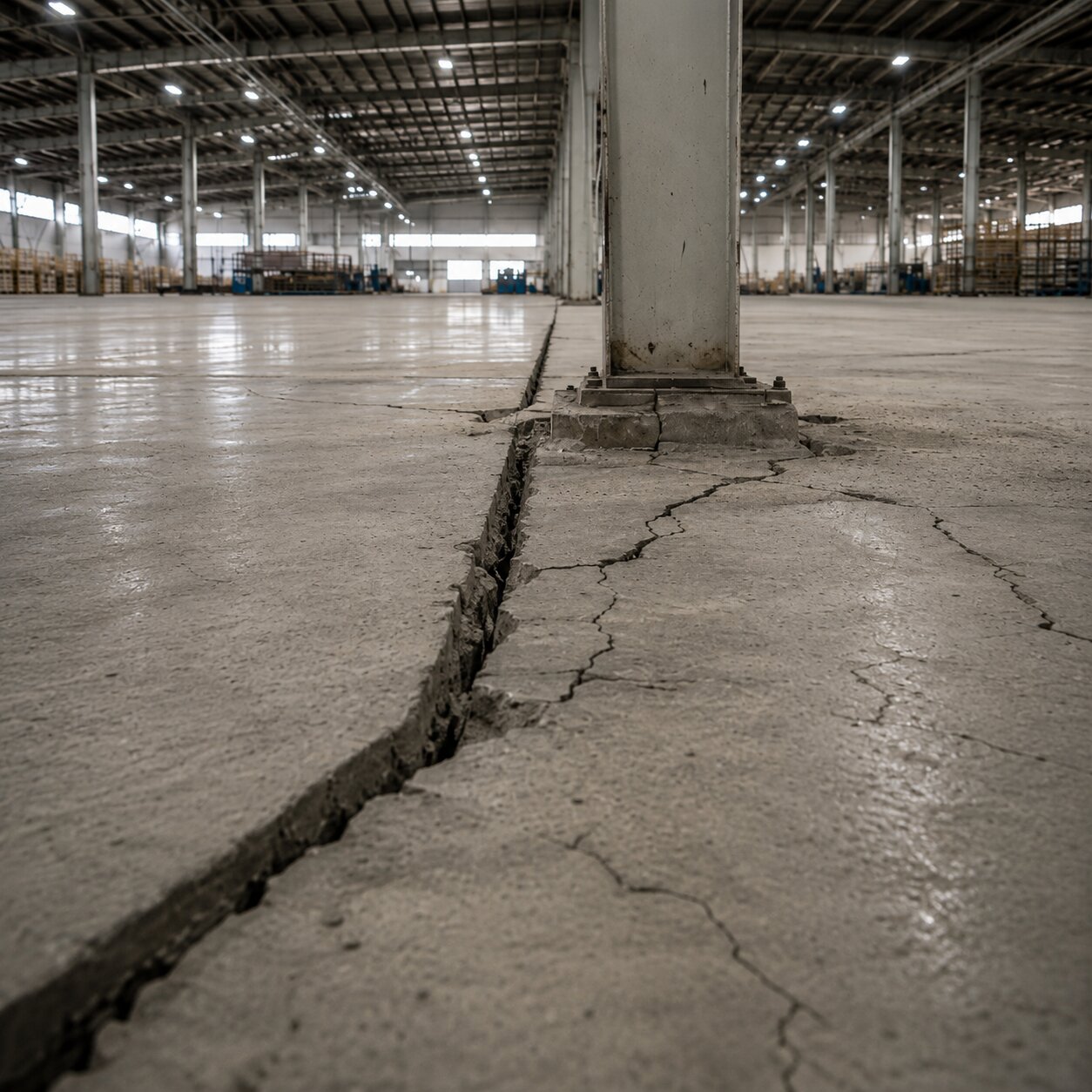
The cracks appear first near the column lines, where the racking meets the floor. Then a joint starts to lift slightly on one side. Then, a few months later, a forklift driver reports that a section of the floor has dropped — not much, maybe 20 or 30 millimetres — but enough to feel it at speed, and enough to worry about what it means for the next ten years.
If your facility sits in Maharashtra, Madhya Pradesh, Gujarat, Karnataka, or Andhra Pradesh, there is a reasonable chance the ground underneath it is black cotton soil. And if that is the case, what you are seeing is not a construction defect. It is the soil doing what black cotton soil does.
What Black Cotton Soil Actually Is
Black cotton soil — known in geotechnical literature as expansive soil or Vertisol, and sometimes called regur — covers approximately 0.8 million square kilometres of India, roughly 21 percent of the country's total land area (Chandran et al., 2012). It formed from the weathering of Deccan basalt millions of years ago, and its dominant clay mineral is montmorillonite.
Montmorillonite has a layered crystal structure that absorbs water between its layers: when wet, it expands; when dry, it contracts. Free swell index — tested per IS 2720 Part 40 — is the standard measure of this behaviour. Black cotton soil samples in published Indian studies have recorded free swell index values above 100 percent, a level classified as 'very severe swelling,' meaning the soil can more than double in volume when saturated.
For agriculture, this moisture-holding capacity is useful — it is why black cotton soil produces good cotton and wheat crops. For an industrial floor slab, it is a serious problem.
The Cycle That Damages Industrial Floors
The structural engineer who designed your facility accounted for the dead load of the building, the live loads from racking and forklifts, and probably the swelling pressure from the black cotton soil beneath the foundations. What is less commonly accounted for is the seasonal moisture cycle operating specifically in the sub-slab zone.
In the dry season — typically November through April across central and western India — the upper layers of black cotton soil lose moisture and shrink. The soil pulls away from the underside of the concrete floor slab, leaving a gap. The slab now carries its load as a bridge across those gaps: something it was not designed to do.
The sub-slab zone is the most under-engineered part of most industrial facilities in India.
When the monsoon arrives, the same soil absorbs water rapidly and expands. If drainage around the building perimeter is imperfect — and in most facilities it is imperfect — water finds its way under the slab through joints, penetrations, and micro-cracks at the slab edges. The expanding soil pushes upward unevenly, because moisture content is never uniform across a large floor plate. One section rises a few millimetres, another stays put, and the joint between them becomes a trip hazard and a maintenance problem.
Repeat this for three or four monsoons, and the floor plate is in a meaningfully different condition from the day it was handed over.
Why This Matters More for Industrial Facilities Than Residential Buildings
Residential buildings on black cotton soil are well understood. Indian building codes address foundation design for expansive soils, and under-reamed pile foundations — developed through research credited to the Central Building Research Institute, Roorkee — have become the standard solution for low-rise structures on black cotton soil. The standard approach is to anchor foundations below the active zone — the depth at which seasonal moisture fluctuation is significant, typically 1.5 to 2 metres.
Industrial floor slabs are a different problem.
A suspended structural floor slab tied to the building frame will move with the frame and distribute loads accordingly. But most industrial facilities use ground-bearing slabs: concrete poured directly onto a prepared sub-base, sitting on the soil. A ground-bearing slab is not designed to span voids. When black cotton soil shrinks away from beneath it, the slab begins to experience bending loads it was never sized for. The surface cracks — diagonal cracks near columns, lifted joint lips, hairline fractures radiating from penetrations — are the slab telling you it is now spanning something it should not be.
This is compounded in facilities with heavy point loads: high-bay racking anchored to the floor, automated storage systems, or heavy press machinery. A void of even 10 to 15 millimetres beneath a loaded rack base plate concentrates stress in a way that can produce visible failure at the surface within a single operating season.
What the Soil Investigation Report Does Not Tell You
Most industrial facilities commission a geotechnical investigation before construction. That report will characterise the soil type, report the California Bearing Ratio (CBR) value, and recommend a sub-base specification. It is a good document, written at a point in time.
What it cannot tell you is how the sub-base will behave five years later, once the seasonal moisture cycle has worked on it — once the expansion joint started leaking, or the drainage channel partially blocked, or the landscaping irrigation crept closer to the building perimeter.
Ground conditions under industrial floors are not static. They evolve with the operational life of the facility.
This is why some facilities on perfectly sound geotechnical reports still develop significant floor settlement over time. The investigation described the starting condition. The problem is what happens next.
When to Take It Seriously
Not all cracking on black cotton soil is an immediate structural problem. Hairline surface cracks at slab joints are common and often cosmetic. The situations that warrant a proper investigation are: a level difference of more than 10 millimetres across a joint; a crack that has widened since it first appeared; a floor section that flexes visibly under loaded forklift traffic; cracks that are propagating into previously unaffected areas; or any settlement near a loaded racking installation where a level floor is a safety requirement.
These are signs the sub-slab condition has changed materially and the slab is working harder than it should.
It is also worth noting that polymer injection cannot solve every problem. If the primary cause is ongoing uncontrolled water ingress — a broken drain, a leaking main beneath the floor, a perimeter that allows monsoon water to pond — the source needs to be addressed before any ground remediation will hold. GeoLift identifies whether water management is part of the picture during every assessment.
What Can Be Done
The traditional response to floor settlement in India is slab replacement: break out the damaged section, prepare the sub-base, pour new concrete. On an active industrial site, this means weeks of downtime for the affected area — disruption to racking, inventory movements, and operations that can cost more than the concrete work itself.
Polymer injection offers an alternative for facilities where the root cause is sub-slab voiding and localised settlement rather than wholesale structural failure. Expanding geotechnical polyurethane injected through small-diameter holes in the slab fills voids, re-establishes continuous support, and in many cases lifts settled sections back toward their original level — while the facility stays operational. Treated areas can typically take traffic within two to three hours.
Where the soil layer is deeply affected, differential settlement is severe, or the slab itself is compromised beyond its reinforcement, more extensive work is needed. Honest assessment of the floor and sub-surface condition is the starting point.
If your facility is in a black cotton soil zone and you are seeing the early signs — diagonal cracks, lifting joints, unevenness that was not there two years ago — it is worth getting it looked at before the next monsoon. The conditions that produce this kind of settlement do not get better on their own.