Why factory floors sink — and what to do about it

Alluvial soil is the silent threat beneath millions of industrial facilities across India. Understanding why it fails is the first step to fixing it permanently.

Cracked dry soil

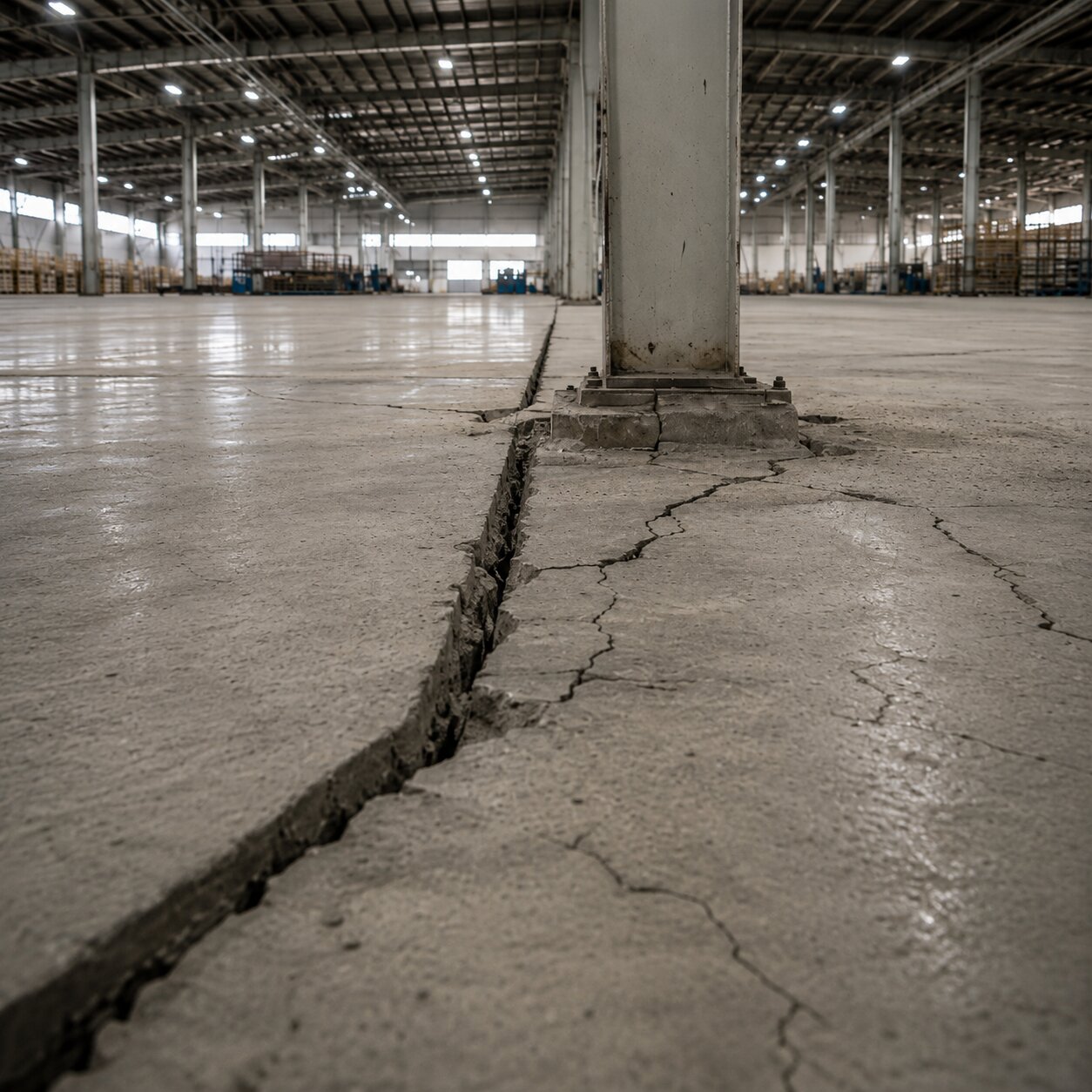
Walk through almost any large factory, warehouse, or logistics hub in the Indo-Gangetic plain and you will eventually find it: a crack running along a column base, a forklift track that has turned into a ramp, or a loading dock door that no longer closes cleanly. These are not cosmetic problems. They are the surface signature of something happening several metres underground.

The alluvial soil problem

A vast swath of northern and coastal India sits on alluvial deposits — sediment laid down by rivers over thousands of years. This soil is notoriously variable. In one borehole you might find dense sandy gravel; in the next, soft silt and clay. Industrial planners and structural engineers have learned to work with this variability at the foundation level, but what happens beneath the slab — the upper 3 to 6 metres of material supporting the floor — is often left to chance.

The sub-slab zone is the most commonly under-engineered part of any industrial facility. It receives less scrutiny than the structural foundation, yet it bears the full brunt of daily operational load.

When a factory is built, the sub-base is typically compacted and a reinforced concrete slab is poured over it. At the time of construction, this feels solid. But alluvial soils are prone to consolidation settlement — the gradual expulsion of water from fine-grained layers under sustained load. A 30,000-square-metre warehouse floor exerts a continuous downward pressure that the soil beneath it was never truly tested for at the timescales involved.

Three mechanisms that cause floors to drop

  • Void formation under slabs. When water (from leaking pipes, monsoon ingress, or poor drainage) washes fine particles from beneath a slab, it leaves voids. The slab then spans these cavities until it can no longer do so — and cracks or sinks.
  • Dynamic loading cycles. Forklifts, heavy racking systems, and loaded trucks create repeated impact loads. Over years, these compact loose sub-base material unevenly, producing differential settlement — the most damaging kind.
  • Shrink-swell in clay-rich zones. Expansive clays shrink during dry seasons and swell during the monsoon. A floor slab bonded to this material moves with it, causing seasonal cracking that compounds over time.

Why traditional fixes don't work

The instinct when a floor sinks is to grind it flat and overlay it with new concrete. This is the most common response across Indian industry, and it is also one of the most expensive and least effective. A 50mm overlay adds dead load to an already stressed sub-base. It masks the problem for two or three years before differential settlement reasserts itself through the new surface.

Breaking out the slab entirely and re-compacting the sub-base is more thorough but requires full operational shutdown, takes weeks, and still does not address voids deeper than the excavation goes.

What actually works

Polymer ground engineering addresses the root cause rather than the symptom. By injecting two-component expanding polyurethane resin directly beneath the slab — through ports drilled at calculated intervals — engineers can fill voids, densify loose material, and lift settled concrete back to level. The process takes hours rather than weeks, and the facility can often resume operations the same day.

At GeoLift, we carry out a thorough ground investigation before any injection programme — assessing void locations, sub-base strength, and differential settlement across the slab. The injection grid is designed from this data, not guesswork.

The goal is not just to lift the floor — it is to eliminate the conditions that caused it to sink in the first place.

For facility managers and operations directors dealing with sinking floors, the key question is not whether to act but when. Settlement is progressive. A 15mm drop that is manageable today will be a 40mm drop with structural implications in eighteen months. Early intervention is always cheaper than late remediation.

Is your floor showing signs of settlement?

GeoLift's ground investigation team can carry out a full sub-slab assessment and give you a clear picture of what's happening beneath your facility — before it becomes a crisis.

Speak to an engineer

Bridge approach settlement: the most expensive pothole in India

Settlement humps at bridge approaches cost India billions in maintenance every year. Polymer injection offers a permanent alternative to the annual overlay cycle.

Bridge road at dusk

Every road engineer in India knows the bump. It appears at virtually every bridge in the country within a few years of construction — sometimes within months. Drivers slow down, heavy vehicles bottom out, and in the worst cases the jolt is violent enough to damage vehicle suspension. This is the bridge approach settlement problem, and it is costing the road network far more than most people realise.

Why approach slabs always settle

A bridge abutment is a rigid structure, typically driven into stable ground or rock. The approach embankment behind it is fill material — compacted earth, often placed relatively quickly during construction. These two materials have fundamentally different stiffness and settlement characteristics. As traffic loads are applied over years, the embankment consolidates while the bridge does not, creating a differential settlement that manifests as a step or ramp at the transition.

The geometry makes the problem self-reinforcing. Once a step forms, vehicles hit it at speed, generating impact loads that are many times higher than the static design load. These dynamic impacts accelerate further settlement, which makes the step worse, which increases the impact load. Left unaddressed, approach slab failures can destabilise the abutment itself.

A 30mm step at a bridge approach on a national highway is not a maintenance inconvenience — it is a structural warning sign and a significant road safety hazard.

The annual overlay trap

The standard response across NHAI, state PWDs, and municipal road bodies is to mill the approach and apply a fresh asphalt overlay each maintenance cycle. This is quick, familiar, and keeps the surface temporarily smooth. It is also almost entirely futile as a long-term solution.

An overlay addresses surface geometry but adds mass to an already overloaded embankment. Within one to two monsoon seasons the settlement reasserts itself, the new surface cracks, and the cycle begins again. The total cost of successive overlays over a 10-year period typically exceeds the cost of a permanent remediation several times over.

The polymer injection alternative

Polyurethane resin injection works differently from any surface treatment. Ports are drilled through the approach slab at a grid spacing determined by the site investigation. Two-component resin is injected under controlled pressure; it expands to fill voids and permeates loose fill material, densifying it and binding particles together. Precision lifting equipment monitors the slab level in real time, raising it back to design grade in increments of as little as 1mm.

  • No excavation required — the slab and road surface remain intact throughout
  • Work can be carried out under lane closure rather than full road closure
  • The hardened polymer is waterproof, meaning monsoon ingress no longer progressively washes out fill material
  • Structural design life of the remediated zone is typically 20+ years

Making the case to decision-makers

For engineers working within government procurement frameworks, the challenge is often not technical but financial. Overlay expenditure sits in routine maintenance budgets. Polymer injection is a capital works item. The two are not compared against each other in most planning cycles, even when the lifecycle economics strongly favour injection.

GeoLift prepares lifecycle cost analyses as part of project proposals — comparing the NPV of repeated overlay cycles against a single polymer remediation programme. For bridges on high-traffic corridors, the case is usually unambiguous within a five-year window.

The best time to treat a bridge approach is when the step first becomes measurable — not when it becomes a news story.

India has over 250,000 bridges on its national and state highway network. The approach settlement problem is present at a significant proportion of them. Solving it at scale requires both the right technology and procurement frameworks that allow lifecycle cost thinking to compete with lowest upfront cost. That shift is beginning to happen, and polymer ground engineering is well positioned to benefit from it.

Working on a bridge approach remediation project?

GeoLift has completed approach slab stabilisation on national highway and state road projects across India. We can provide technical proposals, lifecycle cost comparisons, and site assessments.

Talk to our team

What is polyurethane foam injection and how does it lift concrete?

A plain-English explanation of how two-component expanding polymer resin is used to fill voids, stabilise soil, and lift sunken slabs — without excavation.

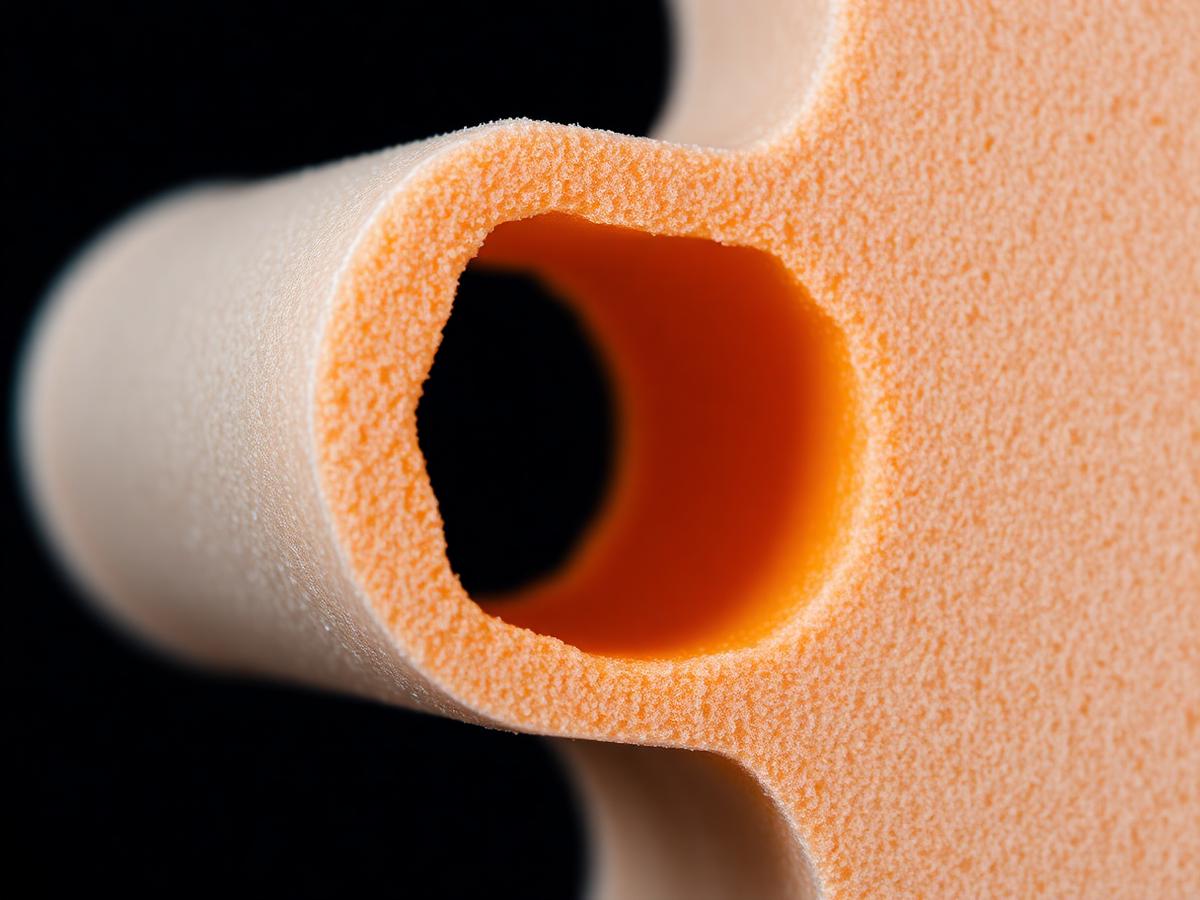
Polyurethane foam close-up

If you search for solutions to a sunken concrete floor, you will encounter terms like "polyurethane foam injection," "polymer lifting," "slab jacking," and "geopolymer grouting." These are not all the same thing, and the differences matter. This article focuses specifically on two-component expanding polyurethane resin — the technology at the core of GeoLift's work — and explains in plain terms how it works, why it works, and where it is most effective.

Starting with the chemistry

Polyurethane is a polymer — a long-chain molecule — formed by reacting two chemical components: an isocyanate (component A) and a polyol (component B). When these two components are mixed, a chemical reaction begins that produces carbon dioxide gas as a by-product. It is this gas that causes the material to expand.

The expansion rate, final density, and structural properties of the cured foam depend on the formulation. GeoLift uses high-density, hydro-insensitive formulations specifically designed for geotechnical applications — these are very different from the low-density spray foams used in building insulation, which would be structurally inadequate for ground engineering work.

Not all polyurethane foams are the same. Ground engineering applications require high-density, hydro-insensitive formulations that can carry structural loads and resist groundwater — properties that standard construction foams do not have.

The injection process, step by step

Before any injection begins, GeoLift carries out a site investigation. This typically includes specialist void detection scanning, sub-base strength profiling, and precision optical levelling to map differential settlement across the slab.

From this data, an injection grid is designed. The port spacing, injection sequence, and target volumes per port are all calculated — this is not a process where you inject and hope for the best.

  • Port drilling. 16mm holes are drilled through the concrete slab at the grid locations. The drilling is fast — typically 30 seconds per port — and produces minimal debris.
  • Probe insertion. A steel injection probe is seated into each port. The probe includes a one-way valve that prevents backflow during injection.
  • Mixing and injection. Components A and B are pumped from separate heated hoses through a static mixing tip at the probe. The mixed resin enters the sub-slab zone in its liquid state — it is thin enough to flow into cracks and small voids before it begins to expand.
  • Expansion and curing. The resin expands to fill the available void space and then begins to densify the surrounding soil by displacing loose particles and binding them. The expansion pressure is controlled by the operator; if the pressure rises too quickly, injection is paused.
  • Lifting. As void space is filled and the expanding resin begins to exert upward pressure on the slab, the slab lifts. This is monitored in real time using digital levels accurate to 0.5mm. The operator controls the lift rate by adjusting injection volume and pausing between ports.
  • Completion and patching. Once the target level is achieved, the injection probe is removed and the port hole is patched with a non-shrink cementitious mortar. The patch is typically invisible within 24 hours.

What happens to the resin underground

Once cured, the polyurethane foam becomes a rigid, closed-cell solid with a compressive strength appropriate to the application. The closed-cell structure means it does not absorb water — an important property for sub-slab work, where groundwater and monsoon ingress are common. The foam does not biodegrade, does not support plant growth, and does not leach chemicals into surrounding soil under normal operating conditions.

The cured material bonds to the underside of the concrete slab and to soil particles, creating a composite zone that is stiffer and more homogeneous than the original sub-base. This is why polymer injection can address the cause of settlement (a weak, voided sub-base) rather than merely treating the symptom (an uneven surface).

What polyurethane injection cannot do

It is important to be honest about the limits of the technology. Polymer injection is not appropriate for every situation:

  • Where the concrete slab itself is structurally compromised (severely cracked, broken, or rotten), lifting it may cause further fracture. In these cases, the slab typically needs partial replacement first.
  • Where settlement is caused by ongoing active loading beyond the original design intent — a warehouse now storing loads far heavier than it was designed for — polymer injection can stabilise and lift, but the underlying design issue remains.
  • In highly organic soils (peat, filled landfill material), expansion behaviour can be unpredictable and injection is generally not recommended without detailed ground investigation.

How long does it last?

High-density polyurethane resin has an expected structural life well in excess of 25 years in typical sub-slab conditions. The material is stable across the temperature range experienced in India, resistant to diesel and light fuel contamination, and unaffected by the wet-dry cycles of the monsoon climate.

GeoLift provides a post-completion levelling survey on all slab lifting work. Our team monitors outcomes and remains available to assess any follow-up requirements after the programme concludes.

The best measure of a polymer injection project's success is simple: does the floor stay level? In our experience, when the initial investigation is thorough and the injection grid is properly designed, it does.

Want to understand whether polymer injection is right for your site?

Every site is different. GeoLift's engineers can carry out a no-obligation assessment and tell you honestly whether polymer injection is the right solution — or whether something else would serve you better.

Request a site assessment

Why Industrial Floors Crack and Sink on Black Cotton Soil

Black cotton soil covers a fifth of India's land area. Here's what it does to industrial floors after the building is handed over — and why it gets worse over time.

Cracked concrete floor in an industrial warehouse

The cracks appear first near the column lines, where the racking meets the floor. Then a joint starts to lift slightly on one side. Then, a few months later, a forklift driver reports that a section of the floor has dropped — not much, maybe 20 or 30 millimetres — but enough to feel it at speed, and enough to worry about what it means for the next ten years.

If your facility sits in Maharashtra, Madhya Pradesh, Gujarat, Karnataka, or Andhra Pradesh, there is a reasonable chance the ground underneath it is black cotton soil. And if that is the case, what you are seeing is not a construction defect. It is the soil doing what black cotton soil does.

What Black Cotton Soil Actually Is

Black cotton soil — known in geotechnical literature as expansive soil or Vertisol, and sometimes called regur — covers approximately 0.8 million square kilometres of India, roughly 21 percent of the country's total land area (Chandran et al., 2012). It formed from the weathering of Deccan basalt millions of years ago, and its dominant clay mineral is montmorillonite.

Montmorillonite has a layered crystal structure that absorbs water between its layers: when wet, it expands; when dry, it contracts. Free swell index — tested per IS 2720 Part 40 — is the standard measure of this behaviour. Black cotton soil samples in published Indian studies have recorded free swell index values above 100 percent, a level classified as 'very severe swelling,' meaning the soil can more than double in volume when saturated.

For agriculture, this moisture-holding capacity is useful — it is why black cotton soil produces good cotton and wheat crops. For an industrial floor slab, it is a serious problem.

The Cycle That Damages Industrial Floors

The structural engineer who designed your facility accounted for the dead load of the building, the live loads from racking and forklifts, and probably the swelling pressure from the black cotton soil beneath the foundations. What is less commonly accounted for is the seasonal moisture cycle operating specifically in the sub-slab zone.

In the dry season — typically November through April across central and western India — the upper layers of black cotton soil lose moisture and shrink. The soil pulls away from the underside of the concrete floor slab, leaving a gap. The slab now carries its load as a bridge across those gaps: something it was not designed to do.

The sub-slab zone is the most under-engineered part of most industrial facilities in India.

When the monsoon arrives, the same soil absorbs water rapidly and expands. If drainage around the building perimeter is imperfect — and in most facilities it is imperfect — water finds its way under the slab through joints, penetrations, and micro-cracks at the slab edges. The expanding soil pushes upward unevenly, because moisture content is never uniform across a large floor plate. One section rises a few millimetres, another stays put, and the joint between them becomes a trip hazard and a maintenance problem.

Repeat this for three or four monsoons, and the floor plate is in a meaningfully different condition from the day it was handed over.

Why This Matters More for Industrial Facilities Than Residential Buildings

Residential buildings on black cotton soil are well understood. Indian building codes address foundation design for expansive soils, and under-reamed pile foundations — developed through research credited to the Central Building Research Institute, Roorkee — have become the standard solution for low-rise structures on black cotton soil. The standard approach is to anchor foundations below the active zone — the depth at which seasonal moisture fluctuation is significant, typically 1.5 to 2 metres.

Industrial floor slabs are a different problem.

A suspended structural floor slab tied to the building frame will move with the frame and distribute loads accordingly. But most industrial facilities use ground-bearing slabs: concrete poured directly onto a prepared sub-base, sitting on the soil. A ground-bearing slab is not designed to span voids. When black cotton soil shrinks away from beneath it, the slab begins to experience bending loads it was never sized for. The surface cracks — diagonal cracks near columns, lifted joint lips, hairline fractures radiating from penetrations — are the slab telling you it is now spanning something it should not be.

This is compounded in facilities with heavy point loads: high-bay racking anchored to the floor, automated storage systems, or heavy press machinery. A void of even 10 to 15 millimetres beneath a loaded rack base plate concentrates stress in a way that can produce visible failure at the surface within a single operating season.

What the Soil Investigation Report Does Not Tell You

Most industrial facilities commission a geotechnical investigation before construction. That report will characterise the soil type, report the California Bearing Ratio (CBR) value, and recommend a sub-base specification. It is a good document, written at a point in time.

What it cannot tell you is how the sub-base will behave five years later, once the seasonal moisture cycle has worked on it — once the expansion joint started leaking, or the drainage channel partially blocked, or the landscaping irrigation crept closer to the building perimeter.

Ground conditions under industrial floors are not static. They evolve with the operational life of the facility.

This is why some facilities on perfectly sound geotechnical reports still develop significant floor settlement over time. The investigation described the starting condition. The problem is what happens next.

When to Take It Seriously

Not all cracking on black cotton soil is an immediate structural problem. Hairline surface cracks at slab joints are common and often cosmetic. The situations that warrant a proper investigation are: a level difference of more than 10 millimetres across a joint; a crack that has widened since it first appeared; a floor section that flexes visibly under loaded forklift traffic; cracks that are propagating into previously unaffected areas; or any settlement near a loaded racking installation where a level floor is a safety requirement.

These are signs the sub-slab condition has changed materially and the slab is working harder than it should.

It is also worth noting that polymer injection cannot solve every problem. If the primary cause is ongoing uncontrolled water ingress — a broken drain, a leaking main beneath the floor, a perimeter that allows monsoon water to pond — the source needs to be addressed before any ground remediation will hold. GeoLift identifies whether water management is part of the picture during every assessment.

What Can Be Done

The traditional response to floor settlement in India is slab replacement: break out the damaged section, prepare the sub-base, pour new concrete. On an active industrial site, this means weeks of downtime for the affected area — disruption to racking, inventory movements, and operations that can cost more than the concrete work itself.

Polymer injection offers an alternative for facilities where the root cause is sub-slab voiding and localised settlement rather than wholesale structural failure. Expanding geotechnical polyurethane injected through small-diameter holes in the slab fills voids, re-establishes continuous support, and in many cases lifts settled sections back toward their original level — while the facility stays operational. Treated areas can typically take traffic within two to three hours.

Where the soil layer is deeply affected, differential settlement is severe, or the slab itself is compromised beyond its reinforcement, more extensive work is needed. Honest assessment of the floor and sub-surface condition is the starting point.

If your facility is in a black cotton soil zone and you are seeing the early signs — diagonal cracks, lifting joints, unevenness that was not there two years ago — it is worth getting it looked at before the next monsoon. The conditions that produce this kind of settlement do not get better on their own.


Is your facility in a black cotton soil zone?

GeoLift's engineers carry out on-site floor and sub-surface assessments across Maharashtra, Gujarat, Madhya Pradesh, Karnataka, and Andhra Pradesh. We'll tell you honestly what's happening and whether polymer injection is the right solution.

Talk to GeoLift about a floor assessment for your facility

Article not found

This article may have moved. Return to all articles