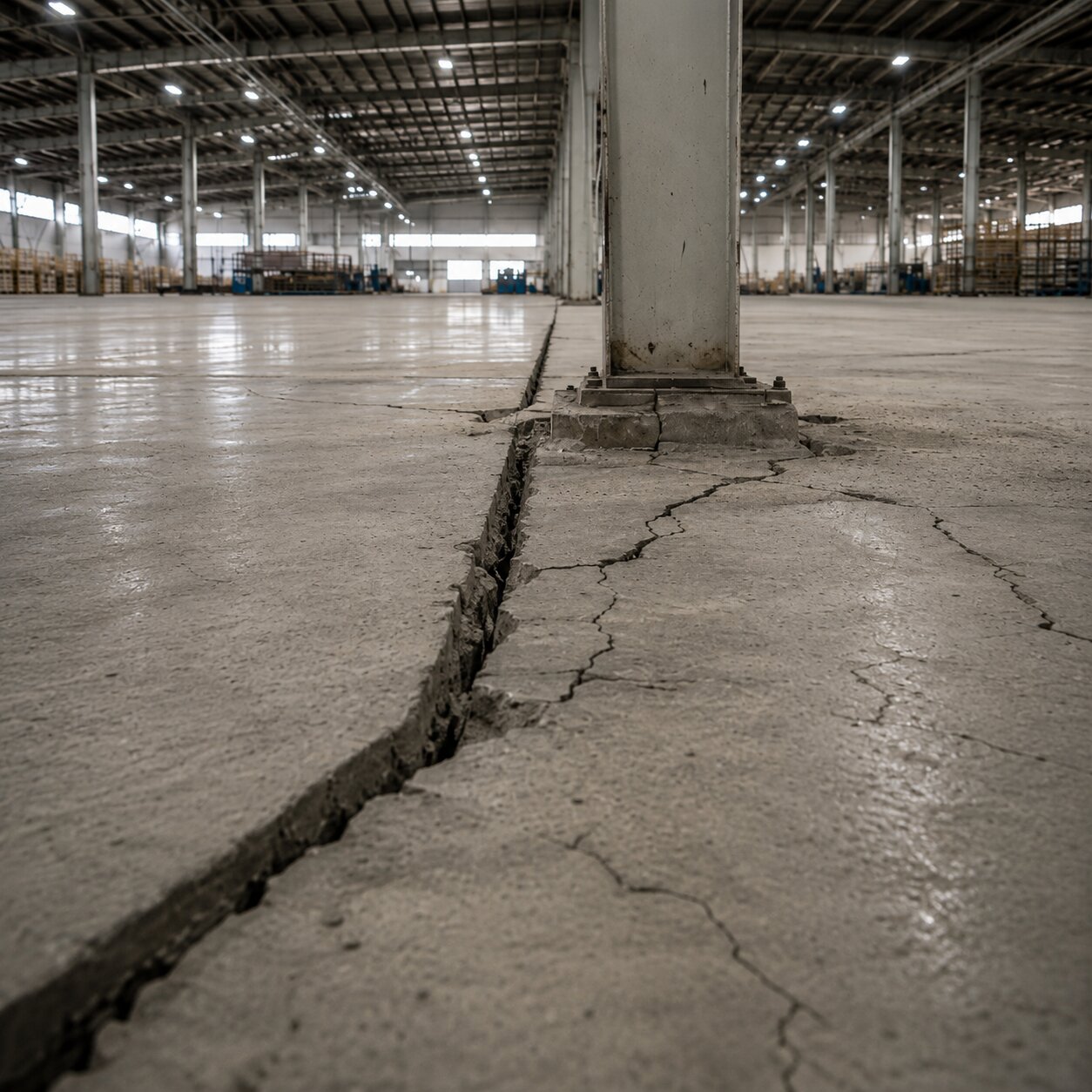
When a section of factory or warehouse floor develops visible settlement — a lifted joint, diagonal cracks near column bases, a section that dips noticeably under loaded traffic — the first question is usually: do we break it out and replace it, or is there another way?
In India, slab replacement has historically been the default answer. It is familiar, it is what the civil contractor knows how to price, and it produces a new floor. The problem is what it costs in practice, and whether it actually solves the underlying problem.
What Slab Replacement Actually Involves
Breaking out a settled section of industrial floor is disruptive in ways that often go uncosted at the decision stage. The affected area has to be cleared — racking stripped out, inventory relocated. A saw-cut perimeter is marked, the concrete broken and removed, the sub-base inspected and recompacted or replaced, new concrete poured, cured, and surface-finished. Cure time before loading: typically 28 days for full strength, though most contractors will allow traffic after 7 days.
For a 200 sq m section of a working warehouse, realistic downtime runs to 3–6 weeks. For a facility processing daily dispatch volumes, the cost of that disruption — in diverted inventory, temporary racking, lost throughput — frequently exceeds the cost of the concrete work itself.
The other issue is that slab replacement addresses the symptom, not the cause. If the sub-base has consolidated or voided due to soft fill, poor compaction, or water ingress, replacing the slab on the same sub-base produces a new slab sitting on the same problem. Settlement can recur.
What Polymer Injection Does Differently
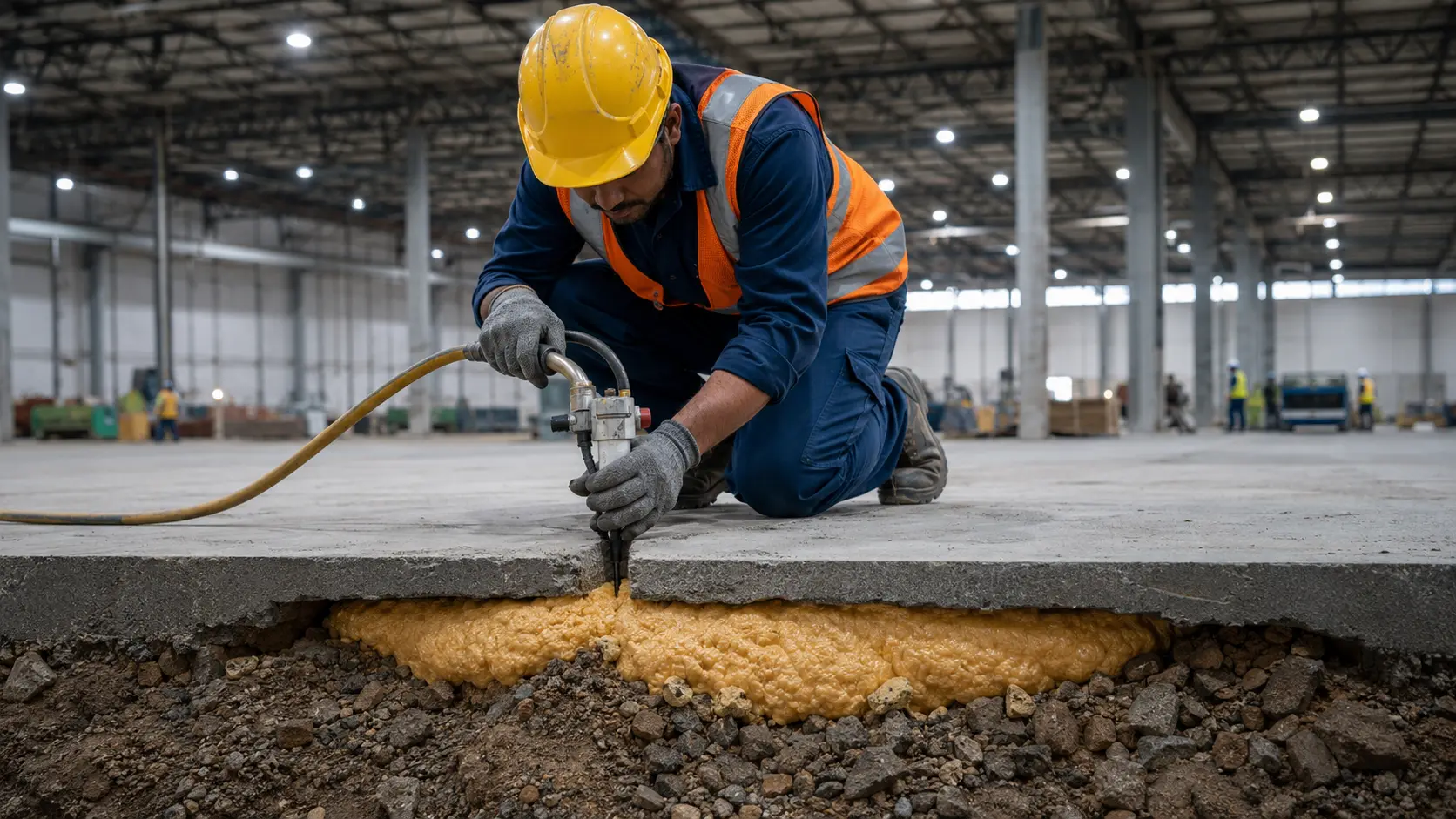
Geotechnical polymer injection approaches the problem from underneath. Small-diameter holes — typically 14–16mm — are drilled through the existing slab at a calculated spacing. Two-component expanding polyurethane resin is injected under controlled pressure. It flows into voids, expands to fill them, and bonds to the sub-base material it contacts. As it expands, it exerts controlled upward pressure on the slab, allowing settled sections to be lifted incrementally and monitored in real time.
The material cures in minutes. Drill holes are patched flush. Treated areas can take operational traffic within a few hours. The entire process on a typical industrial floor section takes one to three days, with no operational shutdown required.
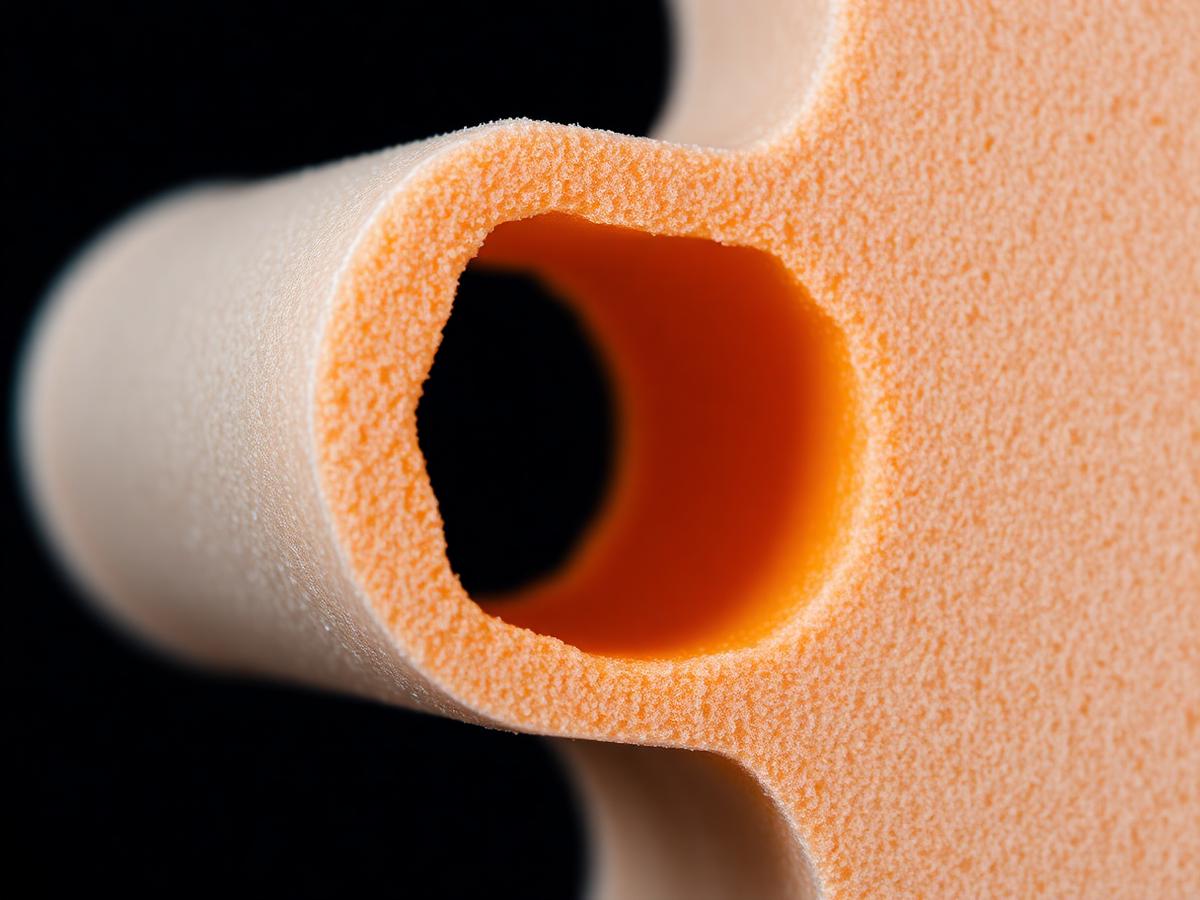
This is not the same as the consumer-grade expanding foam used for cavity filling or pipe sealing. Geotechnical-grade polyurethane is specifically formulated for structural load-bearing applications: higher density, hydro-insensitive (it does not degrade in the presence of moisture), and tested for compressive strength relevant to industrial floor loading.
When Each Method Is the Right Answer
Polymer injection is the appropriate choice when the slab itself is structurally sound — the concrete has not fractured through its depth, the reinforcement is intact, and the problem is the ground condition beneath rather than the concrete above. It works well on consolidation settlement, sub-slab voiding, and differential movement caused by moisture cycling in expansive soils.
Slab replacement is the right answer when the concrete itself has failed: deep cracking across the full slab thickness, spalling that has compromised the structural section, corroded or broken reinforcement, or sections where the slab has broken into multiple pieces that cannot be lifted uniformly. Polymer injection cannot fix concrete that is structurally finished — it can only lift and support concrete that is still intact.
There is also a hybrid scenario: where part of a floor plate is suitable for injection and part genuinely needs replacement. A proper sub-slab assessment — using ground penetrating radar to map void extent and laser survey to quantify differential settlement — will define that boundary clearly before any work begins, which avoids the common mistake of committing to full replacement before understanding what is actually wrong.
The honest position is that polymer injection is not always the answer. But for the majority of industrial floor settlement cases in India, where the slab is intact and the sub-slab condition is the problem, it is the faster, less disruptive, and more targeted option — and it addresses the root cause rather than resetting the clock on the same failure mode.
If your floor has developed settlement and you are weighing the options, the starting point is a ground assessment, not a concrete quote.