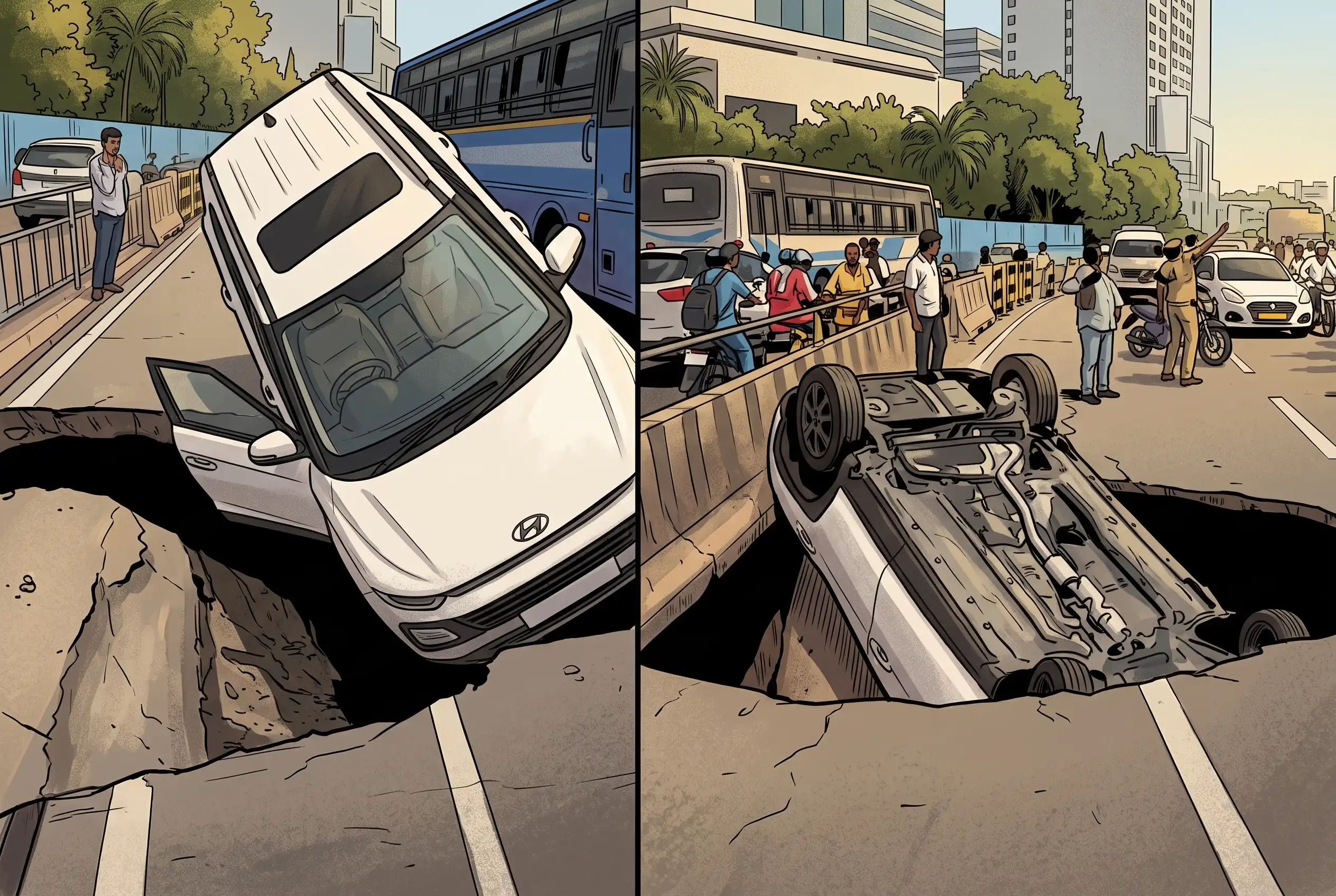
On the morning of 8 October 2026, a car driving along Thiruvanmiyur Road near Tidel Park in Chennai dropped into the ground. The road gave way without warning. The vehicle fell into a ten-foot-deep crater and overturned, with a large section of road collapsed around it. Both passengers survived, but the images made that hard to believe.
The stretch where the collapse happened is an active metro rail construction zone. Chennai Metro Rail Limited confirmed that its Bhavani Tunnel Boring Machine was drilling for Corridor 3 of Phase II — from Tiruvanmiyur to Taramani — immediately adjacent to the site. The cause, once the site was examined, was an ageing sewage pipeline that had failed beneath the road. The soil around it had been eroding for some time. When enough of it had gone, the surface came down.
This was not the first time it had happened on this corridor. In May 2025, a road near Thiruvanmiyur Junction on OMR collapsed into an eight-foot crater after a sewer line leak from a 2.2-metre underground pipe operated by the Chennai Metropolitan Water Supply and Sewerage Board. A family of four and their driver fell into the hole. That site was also near ongoing construction work.
What Large-Scale Construction Does to the Ground Around It
The visible disruption from metro construction is well understood. Traffic diversions, noise, dust, and months of reduced road capacity. These are the things that make headlines.
What happens underground is less visible and less discussed.
When tunnelling machines bore through urban ground, or when piles are driven for station structures, the soil around that work is disturbed. Vibration travels outward through the ground. The material around existing utility pipes, including sewage lines that may be twenty or thirty years old, is loosened slightly. Pipes that had been sitting in stable, firmly compacted ground now have small gaps beginning to form around their joints.
This does not cause an immediate failure. It starts something slower.
Water finds its way through those small gaps. Over weeks and months, it carries fine soil particles with it each time it moves. The particles leave. The gap grows. A void forms, first small, then larger. The road surface above holds because it is stiff enough to span the gap. Then one day the span becomes too wide, or the remaining support too soft, and the surface fails.
In Chennai, the surface that failed was a bituminous road. The void that caused it had been forming for months. The pipeline had probably been leaking before the metro construction started. The construction accelerated what was already happening.
Why Facilities Along the OMR Corridor Face the Same Risk
The Old Mahabalipuram Road corridor is not just a road. It is where a significant part of Chennai's IT parks, logistics warehouses, light manufacturing units, and data centres are located. Many of these facilities were built over the past two decades on ground that has since been heavily disturbed by utility upgrades, drainage work, and now metro construction passing through or near the corridor.
Any facility on this stretch that has underground pipework beneath its floor is carrying the same risk as the road that collapsed near Tidel Park. The mechanism is exactly the same. The only difference is the surface.
A bituminous road collapses when the void beneath it grows too large to bridge. A reinforced concrete floor slab behaves differently. It is stiffer. It can span a larger void before anything appears at the surface. This does not mean the problem is absent. It means the warning signs arrive quietly, and they are easy to miss.
A floor joint that was flush twelve months ago now has a small lip on one side. A section that felt solid now has a faint bounce to it when a loaded trolley crosses. A diagonal crack has appeared near a column base that was not there before. These are not minor maintenance items. They are the floor communicating that the ground below it has changed.
A Pattern Playing Out Across India
Chennai is not the only city where this is happening. The Perambur Barracks Road area of Chennai had its third cave-in since 2021 just days before the Tidel Park collapse, again traced to an ageing underground sewage pipeline. Every Indian city with an active metro project has the same dynamic developing beneath its surface.
In Surat, a ten-foot cavity opened during metro rail construction and residents in nearby buildings had to be evacuated. Officials confirmed that backfilled soil around utility work had been left loose, and the ground had shifted when the tunnelling machine passed nearby. In Bhopal, an under-construction metro pillar tilted due to subsidence at its foundation level during the monsoon.
The common thread is not poor construction. It is the simple reality that large-scale underground construction disturbs the soil in a wider radius than the work itself. The effects show up later, in places that appear unrelated to the construction site, in facilities and roads that no one was watching closely.
What Facility Managers on Active Construction Corridors Should Do
The starting point is knowing whether your facility shows any of the early signs.
Look for changes in floor level across joints, particularly near columns or at the perimeter of the building. Look for cracking that has appeared or widened in the past twelve to eighteen months. Pay attention to any section of floor that feels different underfoot or under vehicle load compared to how it felt a year ago. If your facility sits near an active or recently completed metro construction zone and you have noticed any of these, the sub-surface condition may have changed and should be assessed.
If a void or area of disturbed ground is found beneath a concrete slab, remediation options exist that do not require breaking out the floor or closing the facility. Expanding geotechnical polymer injected through small holes in the slab can fill voids, stabilise disturbed sub-base material, and re-establish consistent support beneath the concrete. The treatment area is back in normal use within hours.
One honest caveat. If construction is still actively underway immediately adjacent to your facility, timing matters. Treating a void while the ground around it is still being disturbed by tunnelling is not straightforward. Assessment is still worthwhile, but the right moment to act is usually after the primary source of ground disturbance has passed.
The road near Tidel Park will be repaired. The pipeline will be fixed. The metro project will continue along the OMR corridor.
What will not repair itself is the sub-surface condition of the facilities that sit alongside it, quietly, while the concrete above holds.